Public Outreach Event within Spoke 7 of the National Biodiversity Future Center

The IRBIM-CNR of Mazara del Vallo participated in a public outreach day dedicated to presenting the activities of Sub-Task 1.6.3 of Activity 1 within Spoke 2: “Solutions to Reverse Marine Biodiversity Loss and Manage Marine Resources Sustainably.” The event took place at the IAS-CNR headquarters in Torretta Granitola, as part of the initiatives promoted by Spoke 7 of the National Biodiversity Future Center.

The event provided a significant opportunity to disseminate the results of the FARO campaign (Fishing Impacts on Isidella elongata Vulnerable Marine Ecosystems). The primary objective of this campaign is to identify and map soft-bottom coral gardens, which are highly valuable ecological habitats characterised by the presence of the Bamboo coral (Isidella elongata), a species classified as ‘critically endangered’ by the IUCN. During the day, the importance of these vulnerable ecosystems was highlighted, also through the projection of images and videos from the explored seabeds.

Posted in$ s

CNR- IRBIM at the National Marine Biodiversity Institute of Korea (MABIK)

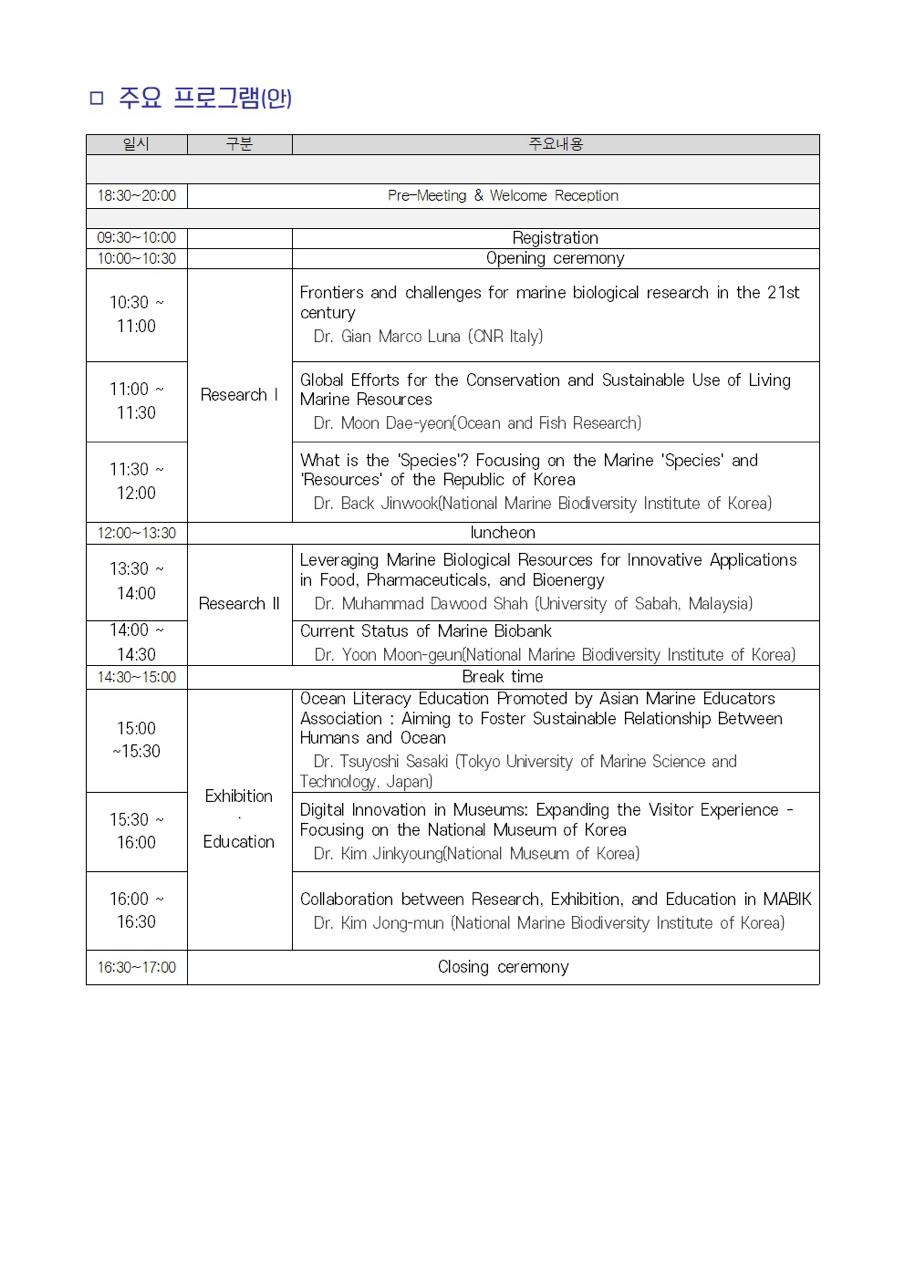
On April 24, 2025, the MABIK International Symposiumwas held in the auditorium of the National Marine Biodiversity Institute of Korea (MABIK) and in the exhibition space called SeaQrium. It was attended by the director of CNR IRBIM Gian Marco Luna with the presentation entitled “Frontiers and challenges for marine biological research in the 21st century“. MABIK is the Korean Institute dedicated to research on Marine Biodiversity. Directed by Kim Hyun-tae, the Mabik aims to contribute to the conservation of marine biological resources and the development of the marine fishing industry through the collection, conservation, exhibition and systematic research of biological resources. Since its opening in 2015, MABIK has achieved significant results in the field of Korean marine biodiversity: it has acquired about 10,000 marine species and a collection of over 600,000 specimens; this allows it to manage a considerable part of the country’s marine biodiversity, precisely 63% of the marine species officially registered in Korea. He also developed the Marine Biodiversity Information System (MBRIS), through which he contributed to the standardization and global sharing of marine biological data. Finally, it led to practical applications, such as the development of commercialised products in the areas of cosmetics and treatments for metabolic diseases, carried out in collaboration with private companies. On this page you can consult the program of the symposium.

Posted in$ s

Annual Conference of the Department of Earth System Sciences and Technologies for the Environment

The Conference of the Department of Earth System Science and Technologies for the Environment (DSSTTA) will take place on 29 and 30 May 2025, in Ancona, at the Mole Vanvitelliana

The conference will address the challenges and opportunities that research will have to face and seize, also in the face of the changes that are happening at European and international level. It will be an opportunity to discuss and reflect on the future of the strategic areas of the DSSTTA, as well as on the paths and initiatives that can contribute to giving science a fundamental role in the renewed political, social and economic context. In those days it will be possible to visit the CNR Research Ship “Gaia Blu“.

The conference program and how to participate and register are available on the dedicated page.

Posted in$ s

Participation of IRBIM CNR Mazara del Vallo at the Subregional Committee for the Central Mediterranean (SRC-CM) – Palermo, Italy | 8–10 April 2025

Researchers from the IRBIM CNR of Mazara del Vallo took an active part in the recent Subregional Committee for the Central Mediterranean (SRC-CM), organized by the General Fisheries Commission for the Mediterranean (GFCM). The meeting, held in Palermo in a hybrid format from 8 to 10 April 2025, brought together experts, researchers and policymakers to discuss the main issues related to the sustainable management of fisheries in the Central Mediterranean. It was an important opportunity for technical discussion, updating on the state of fish resources and sharing recommendations aimed at improving fisheries governance in line with GFCM strategies.

During the event, IRBIM CNR researchers provided significant contributions on various topics. In particular, Fabio Falsone presented an update on the state of demersal resources in the Strait of Sicily, while Germana Garofalo illustrated a preliminary study on the effectiveness of Fisheries Restricted Areas (FRAs) in the region. Matteo Barbato highlighted the ecological importance of Essential Habitats for Fishery Resources in support of management activities, while Michele Luca Geraci presented the results of a selectivity survey conducted as part of an FAO Tender, aimed at reducing unwanted catches in trawling of crustaceans. Two experimental fishing nets, one equipped with sorting grids and another with a T-90 bag, were compared to a commercial net.

The IRBIM CNR team was also involved in other relevant sub-regional technical activities. In the field of spatial management, Valentina Lauria presented a study on the identification of the last hotspots of the critically endangered bamboo coral species Isidella elongata, fundamental for the conservation of Vulnerable Marine Ecosystems in the Central Mediterranean.

Regarding vulnerable species, Fabio Fiorentino and Sergio Vitale reviewed current management measures to mitigate by-catches of elasmobranchs, offering an updated overview of existing approaches. In addition, Germana Garofalo contributed to the discussion with a presentation on the PROSHARKS project, a PRIN-funded initiative, which addresses the urgent need to fill knowledge gaps and protect threatened coastal shark species living on the edge of extinction in this region.

Sub-regional Committees (SRCs) play a crucial role within the CFCM’s operational framework, offering a technical platform to support sustainable fisheries management at sub-regional level. Their mission is to provide technical advice to the Scientific Advisory Committee (SAC), assess progress in fisheries management through the analysis of national data and existing measures, and propose improvements or alternative strategies based on regional needs. They are also in charge of drafting future work plans and addressing new challenges in line with GFCM’s strategies.

Importantly, the work of these committees — including the implementation of action plans and the identification of sub-regional priorities — is actively supported by the MedSea4Fish project, which ensures a collaborative, science-based approach to the long-term protection of Mediterranean fishery resources.
Posted in$ s

“Linea Verde” in Ancona

The episode of Linea Verde Italia made a stop in the Marche region, and in particular in the lively city of Ancona. Researchers from CNR-IRBIM and the Polytechnic University of Marche were also involved in the discovery of the wonders and activities of the area.
The shots at sea were led by colleagues who illustrated some activities carried out within the NBFC – National Biodiversity Future Centre , the research center dedicated to the in-depth study of marine biodiversity and the development of innovative strategies for its preservation, a crucial issue for the health of our planet. Here is the link to watch the episode again

Posted in$ s

The disappearance of Gianna Fabi

With deep sorrow, the Institute for Biological Resources and Marine Biotechnology (CNR-IRBIM) announces the death of Gianna Fabi who has dedicated over 40 years of his career to marine research. In the words of the director: “Gianna was an esteemed colleague and a passionate researcher, whose scientific contribution has enriched not only our Institute, with particular reference to Ancona, but also the wider marine scientific community. She has always participated with dedication in the Working Group on Artificial Reefs; she has also contributed as an expert to prestigious working groups such as GFCM, CITES, EFARO and STECF and has built and conducted dozens and dozens of research projects”. Her death leaves a deep void in the scientific community, which will miss her strongly.

Posted in$ s

ICES/FAO Working Group on Fishing Technology and Fish Behaviour (WGFTFB25)

IRBIM CNR Mazara del Vallo is pleased to announce the next annual meeting of the ICES-FAO Working Group on Fisheries Technology and Fish Behavior (WGFTFB), which will be held in Mazara del Vallo, Italy, from Thursday 15 May to Tuesday 20 May. The working group is an excellent opportunity to discuss all aspects of fisheries technology and fish behaviour, including recent developments at Mediterranean level. Topics to be discussed will include:

  • The use of indicators to describe and compare the performance of fishing gear (Indicators);
  • Abandoned, lost or discarded fishing gear (ALDFG);
  • Operational and technical constraints of fishing gear to support coexistence with offshore wind energy and open water aquaculture (Multiple Use).

Thematic sessions will include:

  • Collection and standardization of the parameters of mobile fishing gear in contact with the bottom and their fuel consumption;
  • Advances in sustainable fishing practices and their impact on marine ecosystems.

Registration for the meeting is open until April 11. For more information about the event and the topics that will be covered, please visit the official website of the meeting: https://wgftfb.org/annual-meeting/meeting-information/ . Abstract submission is now open! Submit your abstract here: https://wgftfb.org/annual-meeting/abstract-submission/ . We look forward to welcoming you to Mazara del Vallo.

Posted in$ s

IRBIM and YACademy Collaboration

The collaboration between CNR-IRBIM and YAC- Young Architects Competitions continues successfully. Following the support for the competition “Iron Island” to write the future of ancient oil platforms, the Advanced Training Course “Concept Design for Architecture” will be held in 2025 to encourage research in design by providing concrete themes and generating solutions for modern challenges. The course includes participation as lecturers by colleagues Gian Marco Luna and Pierluigi Penna from IRBIM in Ancona for the module “Climate Change and Environmental Challenges – Habitats in the Post-Anthropocene”. The goal is to offer a structured criterion with content from various disciplines to stimulate creativity and guide designers in generating original and successful architectural ideas with an innovative approach. As sea professionals, the colleagues will illustrate the changes in marine space caused by human interaction and the scientific questions that require, for example, the creation of low-impact infrastructures. Climate change entails increasingly pressing challenges that require innovative and sustainable solutions to mitigate the effects of global warming and build a more sustainable future, even for marine ecosystems. All these challenges must be addressed with multi-disciplinarity and the meeting of professionals from different sectors. For information and dissemination of the initiative, it is possible to consult the Yacademy website. It is possible to watch presentation videos of the past competition Iron Island; and the official presentation video of the course Concept Design for Architecture”.

Posted in$ sTagged$ s

Final day of the Life+Delfi project

On Tuesday, December 11, in the magnificent setting of the Mole Vanvitelliana in Ancona, the final meeting of the project Life+ Delfi, an European project that addresses the issue of interactions between dolphins and fishing activities, developing sustainable management solutions and models for dolphin-fishing interactions, was held. The day was an opportunity to showcase the work of the Life Delfi team, make a final assessment, and most importantly, think about the future. Life Delfi has produced research, monitoring, and has also built a close collaboration with fishermen to promote sustainable fishing practices. The experimentation of solutions to keep dolphins away from fishing nets included the installation of acoustic and visual deterrents on fishing gear, the promotion of alternative fishing gear, and the development of dolphin observation activities. The project also invested heavily in raising awareness among fishermen and the public about the importance of dolphin conservation, generating a great deal of information. Coordinated by Alessandro Lucchetti, with Massimo Virgili, Andrea Petetta, Daniel Li Veli from CNR IRBIM, Life Delfi was built with numerous partners: the Marine Protected Areas of Egadi Islands, Torre del Cerrano, Punta Campanella, and Tavolara, Filicudi WildLife Conservation, Legambiente Onlus
University of Siena, Blue World Marine Research and Conservation Institute (Croatia), Marine Research Institute of Rovinj (Croatia), Marine Research Institute of Split (Croatia), Marine Research Institute of Dubrovnik (Croatia), National Association of Professional Fishermen (Italy), National Association of Sport Fishermen (Italy), National Association of Amateur Fishermen (Italy), and National Association of Amateur Fishermen (Croatia). On the LifeDelfi website, you can find numerous videos and documentary material produced over the 5 years of the project; the official recording of the final day is visible here.

Posted in$ s

PER24 Campaign – Pollutants’ Environmental Research 2024

The scientific campaign PER24 – Pollutants’ Environmental Research 2024 aboard the CNR research vessel Gaia Blu started from the port of Bari on October 12 and ended on October 28, 2024. The investigations were conducted within the Italian Exclusive Economic Zone of the Southern Adriatic Sea/Northern Ionian Sea, adopting a multidisciplinary approach. Studies on sediments and the water column, geophysical surveys, and geochemical analyses were carried out.

The objective of the PER24 campaign is to assess the extent of anthropogenic alterations in the Southern Adriatic Sea and the Strait of Otranto, with particular attention to the levels of contamination present and the pathways of various pollutants from coastal areas to their deep basins. Therefore, scientific activities have been conducted and are planned in various fields: determination of concentrations of historical pollutants (heavy metals, polycyclic aromatic hydrocarbons, nonylphenols) and emerging pollutants (per- and polyfluoroalkyl substances, pharmaceuticals and personal care products, bisphenol A); analysis of carbon, nitrogen, and their stable isotopes; bathymetric surveys and geomorphological characterization of the seabed; oceanographic characterization of water masses and their circulation patterns; sedimentological investigations; characterization of the microbial community; taxonomic classification of benthic foraminifera communities. All data will be made available in Open Science according to FAIR principles upon processing or publication in scientific journals. IRBIM was able to count on the participation of Federico Spagnoli (Scientific Director of the campaign), Rocco De Marco (Mission Leader), Gaspare Avanzato, Alessandro Di Cola, Chiara Evangelista, Angela Freddi, and Sarah Pizzini, who carried out all activities on board together with other colleagues from various institutions. The campaign is indeed the result of collaboration with the staff of ISPRA from the Chioggia and Rome offices, with the University of Urbino “Carlo Bo”, the Polytechnic University of Marche, the University of Camerino, the CNR-ISP of Rome, Venice, and Bologna, the Ca’ Foscari University of Venice, and the Fano Marine Center. Here is the final report of the PER24-Pollutants’ Environmental Research 2024 campaign.

Posted in$ s
error: Content is protected !!