
Activities for the MITICA project

The activities for the MITICA project—Integrated Mussel Farming for Protection, Innovation, and Adaptation Capacity to Climate and Environmental Change—are ongoing between Lesina and Ancona. The project aims to safeguard mussel farming in Taranto, which is currently threatened by marine heatwaves and deoxygenation. Through scientific innovation and advanced monitoring, the project seeks solutions to increase the resilience of mussels to climate change while promoting environmental sustainability and the circular economy in the Mar Piccolo. IRBIM is actively involved in several research lines crucial to the project’s success. Here a summary of the key research actions:
Task 1, Action 1A (Thermal Resistance): Led by R. Carlucci (CONISMA) and A. Miccoli (CNR-IRBIM Ancona), this involves “Heat-Hardening” experiments to study the thermal resistance of mussels.

Task 1, Action 1B (Oxygen Stress): Led by A. Specchiulli (CNR-IRBIM Lesina), this focuses on in vitro experimentation regarding stress induced by oxygen deficiency. The goal is to analyze the effects of hypoxia on Mytilus galloprovincialis, specifically measuring biological responses through oxidative stress biomarkers. The team in Lesina (A. Specchiulli, T. Scirocco, P. Augello, P. Schiavone, C. Sacchetti, and A. D’Amore) prepared tanks for samples collected from Taranto’s Mar Piccolo. After an acclimatization period, the mussels were transported to the laboratory in Orbetello for hypoxic stress testing.

Task 1, Action 3 (Physiological State): Led by A. Spagnolo with Co-representative F. Donato (CNR-IRBIM Ancona), this evaluates the physiological and gonadal status of the animals. Seasonal biological analyses are conducted at the Lesina laboratories to understand how environmental factors influence growth and reproduction, providing essential data for sustainable management.

Task 2, Action 3 (Carbon Sinks): Led by A. Specchiulli with Co-representative T. Scirocco, this investigates the role of bivalves as natural “carbon sinks.” The team studies how climate change affects their calcification capacity and the specific percentage of carbonate ions stored in the shells of mussels under stress
Posted in$ s

EM4SSF- Project to monitor small-scale fisheries in Europe

February 2026. The EM4SSF project (Enhancing Monitoring for Sustainable Small-scale Fisheries) has reached already few milestones. The initiative aims to improve knowledge of small-scale fisheries (SSF)—a fundamental sector often characterized by limited data—through the integration of advanced geo-spatial technologies and international cooperation.

EM4SSF will focus on five case studies, Italy, Spain, Portugal, Denmark, and Greece, through which a common framework for data processing will be promoted. The project will facilitate information exchange between research institutes and regions, aiming to support the adoption of advanced tracking systems in full compliance with the new EU Regulation 2023/2842. To stay updated on the project’s progress, the official project newsletter has been launched.

Posted in$ s

Un commosso addio alla Professoressa Serena Fonda Umani

It is with profound sadness that the Institute for Marine Biological Resources and Biotechnology (IRBIM) and the entire scientific community bid farewell to Professor Serena Fonda Umani, former Full Professor at the University of Trieste. Her passing leaves a significant void in the national and international marine research landscape, and in all those who had the honor of knowing and collaborating with her.
Professor Fonda Umani was a scientist of exceptional expertise and undisputed renown in the field of Marine Microbial Ecology. Her dedication to scientific inquiry led her to become one of the early female pioneers in Italian oceanography, embarking on expeditions that saw her operating from the Mediterranean Sea to Antarctica.
Beyond her prolific scientific contributions, Professor Fonda Umani served as a cornerstone for the entire community. Her conduct was always marked by loyalty, integrity, and professional ethics—qualities that enriched every workplace and made her a role model for future generations. Only a few months ago, the scientific community had the privilege of paying tribute to her with a Lifetime Achievement Award during the Biodiversity Forum organized by the NBFC – National Biodiversity Future Center in Milan.
In this moment of grief, IRBIM wishes to remember her through her own words and passion, sharing this interview given a few years ago. In it, she speaks with clarity and love about the beauty of being a marine biologist and the crucial importance of studying the ‘infinitely small’ within our seas and oceans.

Posted in$ s

ISPRA Conference: the Sea for the common well-being

On November 20, 2025, the Italian Institute for Environmental Protection and Research (ISPRA) gathered experts, institutions, and political representatives in Rome at the MAXXI – National Museum of 21st Century Arts for the conference “ISPRA: the Sea for the common well-being.”
The event took place in the MAXXI Auditorium, offering a splendid setting and reinforcing the thematic link with the marine environment. The day was also developed from the collaboration born for the creation of the installation “ENTRATE: Nacho Carbonell, Memory, in practice” which welcomed participants and Museum visitors, and in which nets recovered from the Mediterranean and tree trunks find a second artistic life.
The conference was structured into five thematic sessions: knowing the state of health of the seas, protecting biodiversity, the blue economy, the One Health principle, and communicating the sea. It offered a fundamental platform for defining shared strategies for a sustainable future for our Mediterranean. The conclusions were entrusted to Luigi Ricci, ISPRA’s Director.
IRBIM was a protagonist in two key moments of the day, testifying to its commitment to research and dissemination. The Director, Gian Marco Luna, took part in the panel titled “Blue Economy: sustainability and innovation for the future of the sea.” The debate focused on crucial topics such as fishing, aquaculture, bioeconomy, renewable energy, and climate, underscoring the role of scientific research in guiding the sustainable growth of economic activities linked to the sea.
Furthermore, Prof. Donato Giovannelli of the University of Naples Federico II, an IRBIM associate, spoke during the panel dedicated to communication, aptly called “Communicating the Sea.” The panel, moderated by Donatella Bianchi (RAI), focused attention on scientific communication and environmental education for the Sea, highlighting how dissemination is fundamental for raising citizen awareness on the themes of protecting and maintaining the health of marine ecosystems.

Posted in$ s

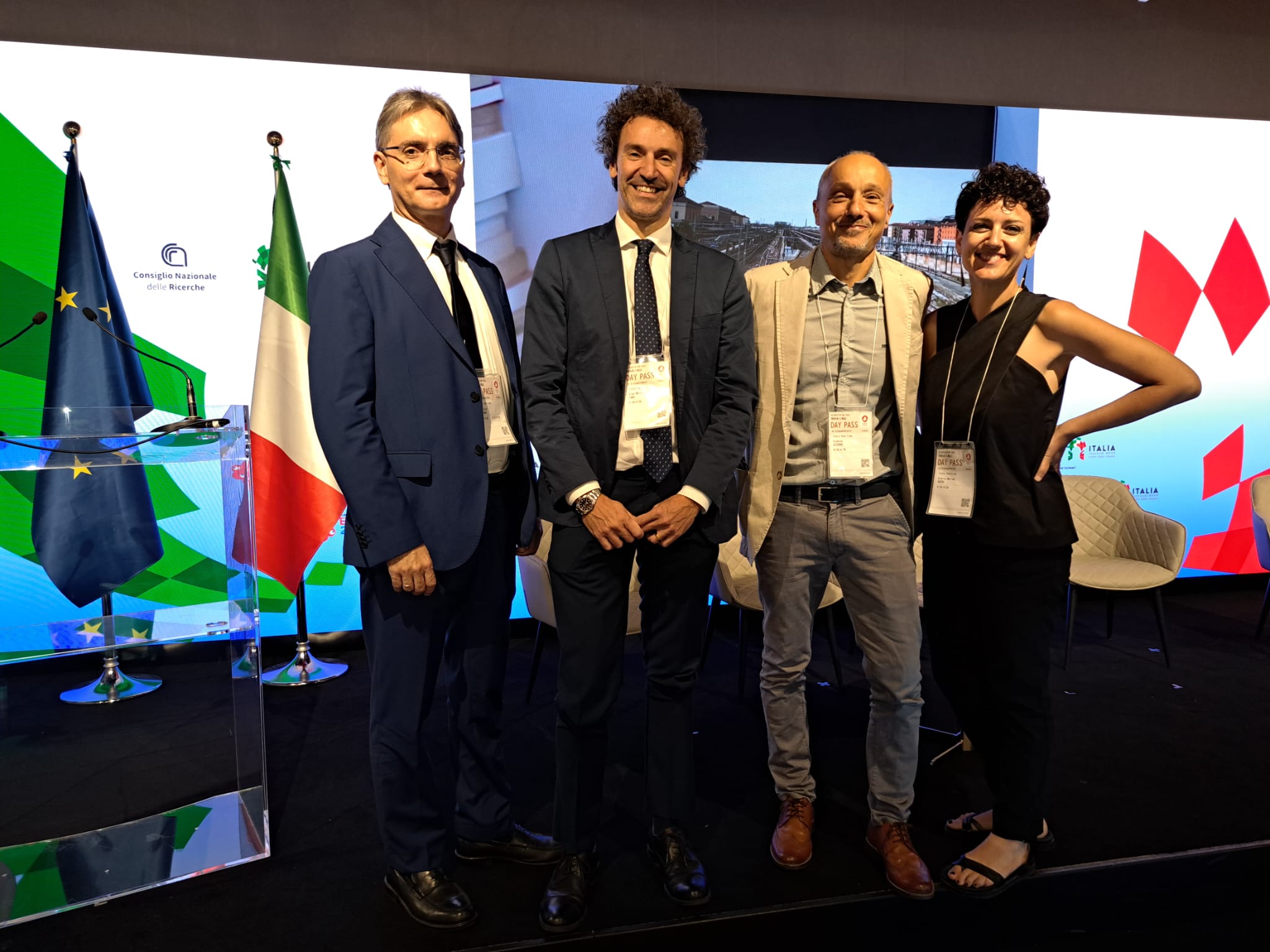
XIV China-Italy Science and Technology Week: a bridge of collaboration for a sustainable future”

The National Research Council (CNR) participated in and sponsored the XIV Edition of the China-Italy Science, Technology and Innovation Week, an internationally recognized event that took place from November 13 to 15, 2025, in the cities of Beijing and Hangzhou. The event confirmed its status as a consolidated model for boosting innovation and building a sustainable future together between the two countries. This edition held particular significance, falling in the year of the 55th anniversary of diplomatic relations between Italy and China, an occasion that underscores their cooperation founded on shared growth and cultural exchange. The centrality of institutional dialogue was further reinforced by the Action Plan for Strengthening the Italy-China Global Strategic Partnership 2024–2027, with the aim of boosting relations between the research and innovation systems to enhance national excellence. The event, promoted in Italy by the Ministry of University and Research (MUR) and coordinated by the IDIS Foundation-Città della Scienza, was organized by the Beijing Municipal Science & Technology Commission and the Administrative Commission of Zhongguancun Science Park, in collaboration with the International Technology Transfer Network. he Week was inaugurated on Thursday, November 13, in Beijing with an Institutional Ceremony attended by the Italian Minister of University and Research, Anna Maria Bernini, and the Minister of Science and Technology of the People’s Republic of China, Yin Hejun. This official moment culminated in the signing of Cooperation Agreements between institutions, universities, research bodies, and companies from the two countries, designed to launch new joint projects. Subsequently, the day continued with thematic sessions focused on Advanced Manufacturing, Ethics and Law of Artificial Intelligence, and Life and Health Sciences, followed by One-to-One meetings and visits to Research Centers and Laboratories. The activities moved to Hangzhou for the day of Friday, November 14, where the focus shifted to key themes such as Cultural Heritage Preservation and Artificial Intelligence, Tropical Agriculture, and, particularly, Marine and Polar Sciences, which include biodiversity and climate change. The forum dedicated to Marine and Polar Sciences represented a significant moment for the Italian research system, with the participation of prominent figures from various institutions. Among the Italian speakers present, Roberto Bassi, President of the Anton Dohrn Zoological Station, presented “Italian Research in Marine Biology.” The CNR contributed with a presentation by Gian Marco Luna, Director of the Institute of Biological Resources and Marine Biotechnologies, on the “Frontiers and challenges of marine biological research in the 21st century,” and with an intervention by Luca Bolognini on experiences related to the “Value of Biodiversity and Health of Marine Ecosystems” for the National Biodiversity Future Center (NBFC). The polar dimension was addressed by the Director of the National Institute of Oceanography and Experimental Geophysics, Fausto Ferraccioli, who updated participants on “Recent Italian contributions to polar research.” The XIV China-Italy Week concluded on Saturday, November 15, with visits and experiences dedicated to traditional Chinese craftsmanship and intangible cultural heritage, thus consolidating the link between scientific innovation and cultural enhancement.

Posted in$ s

Cooperation Agreement between the CNR and the Japan Society for the Promotion of Science (JSPS)

The ceremony for the signing of the renewal of the Cooperation Agreement between the CNR and the Japan Society for the Promotion of Science (JSPS) was held on September 18, 2025, in Tokyo, at the residence of the Italian Ambassador Gianluigi Benedetti. With this renewal, the National Research Council has once again taken significant steps to intensify and internationalize Italian research, consolidating the collaboration with important scientific institutions in Japan. The agreement was signed by the Director of the Department of Chemical Sciences and Materials Technology, Lidia Armelao, representing the CNR President Andrea Lenzi. Among those present were also the Director of the Department of Earth System Science and Environmental Technologies, Francesco Petracchini, and the CNR’s International Relations Office, as well as the Director of IRBIM, Gian Marco Luna. The Scientific Attaché and Ambassador Benedetti opened the ceremony, praising the agreement as an effective tool for promoting research exchanges between our countries and opening new perspectives for the future. Director Armelao recalled how the partnership between CNR and JSPS is a ‘reference partnership,’ founded on crucial values such as mutual respect and the training of young researchers. This appreciation was reiterated by the President of JSPS, Tsuyoshi Sugino, who expressed the hope that the collaboration can further expand in the future. Further solidifying the Italian presence and commitment, another significant bilateral agreement was finalized on the occasion of EXPO 2025 in OSAKA: the one between the CNR and JAMSTEC (Japan Agency for Marine-Earth Science and Technology). The agreement for Italy was signed by the Department Director DSSTTA Francesco Petracchini, sealing an important collaboration in the scientific sector. These recent successes testify to the CNR’s constant commitment to the internationalization of research and the support and full participation of IRBIM in these activities.

Posted in$ s

Osaka Expo 2025 – CNR Day

19 September 2025, Osaka. The Italian Pavilion at Expo 2025 Osaka Designing Future Society for Our Lives” hosted the “CNR Day: – Knowledge as the Key to Protection,” a high-profile event organized by the National Research Council (CNR), through the Department of Earth System Science and Technology for the Environment (CNR-DSSTTA), dedicated to science as an indispensable tool for environmental protection and global resilience. As is the goal at all EXPOs, the objective was to build bridges; in this particular case, a bridge between Italy and Japan on Environmental Issues. The day featured a rich program of bilateral exchanges between Italian and Japanese scientists engaged in research experiences on five crucial environmental themes. The central point has been the role of scientific knowledge, based on data memory and analysis, as a crucial element for understanding the evolution of environmental changes and addressing global challenges. The five pillars of the scientific discussion were: Biodiversity, Sea, Polar Regions, Climate Change, and Natural Risks.

IRBIM made a valuable contribution to the event, both in its scientific and organizational aspects. Ernesto Azzurro presented in the section titled “Fisher’s Memories: Stories That Tell of Ecological Change” The presentation was conducted together with Japanese colleagues Takehito Yoshida and Mayumi Fukunaga from the University of Tokyo, highlighting international cooperation in the field of ecological change. La collega Grazia Marina Quero ha svolto un ruolo cruciale, partecipando attivamente al team che ha organizzato l’evento, sotto la guida del DSSTTA. The institute was also represented by its Director. Gian Marco Luna.

The “CNR Day” was not just a scientific forum, but also a moment to highlight the deep connection between art and science. The event was enriched with artistic content through “Cartografie liquide”, an exhibition that featured a compelling choral projection of six videos created by Italian female artists. For an innovative communication, cartoonist and illustrator Gabriele Peddes translated the content of the scientific presentations into real-time illustrations and comics. Further information about the day’s activities is available on the DSSTTA page dedicated to Expo Osaka 2025. Finally, the event aimed to stress a key message: the only path to protecting our planet is through deep, shared knowledge, making science the most effective shield against the uncertainties of the future..

Posted in$ s

Plastic Reborn

Plastic Reborn is an initiative and a documentary that shows concrete and innovative solutions to stop plastic pollution. The goal is to show how young minds and researchers in the field are creating an alliance between the environment and business to face a global challenge and transform it into a rebirth opportunity. One of the stories at the heart of this project is the one that comes to life in the port of Ancona, where, at 2 a.m., the fishing boat Barracuda I sets sail for a special mission. For an entire day, the boat becomes an open-air laboratory that unites maritime tradition with scientific research. On board are the fishermen, two researchers from the CNR IRBIM of Ancona, and the director and producer. Every time the nets come up from the seabed, the waste of our time emerges along with the fish: bottles, ropes, and styrofoam remnants. In just ten months, only two boats have brought about three tons of debris ashore, 80% of which is plastic.

Questo è il cuore del progetto di Fishing for Litter, coordinato dal CNR IRBIM all’interno dello Spoke 2 del NBFC – National Biodiversity Future Center. The initiative also transforms fishermen into guardians of the sea. Each piece of plastic waste is cataloged, analyzed, and, when possible, sent for recycling, despite obstacles like encrustations and wear and tear. L’IRBIM CNR di Ancona è partner scientifico e patrocinatore del progetto, con il grande impegno delle colleghe Elisa Punzo e Maria Chiara Catta

Il documentario, dal titolo completo “Plastic Reborn, how young minds turn river waste into new beginnings” è prodotto da Carlo Mameli Video Agency, e racconta il conflitto tra un futuro possibile e un presente che resiste. The documentary, with the full title “Plastic Reborn, how young minds turn river waste into new beginnings,” is produced by Carlo Mameli Video Agency and tells the story of the conflict between a possible future and a present that resists.L’obiettivo è mostrare che la speranza è fatta di preparazione, ingegno, nuove tecnologie e nuovi cicli di vita, mettendo in luce il valore dell’intera filiera: dal degrado alla rinascita della plastica. The stories, faces, hands, and courage of those who don’t look the other way will be part of a film intended for international platforms and environmental-themed festivals.

To know more about the project Fishing for Litter and the stories presented by images collected on the field here the link to the page. Here the link to the video interview to Elisa Punzo.

For general information: https://plasticreborn.com

Posted in$ s

DSSTTA Conference

On May 29th and 30th, 2025, the DSSTTA – Department of Earth Science and System and Technologies for the Environment conference took place at the Mole Vanvitelliana in Ancona. The event received logistical support from colleagues at CNR-IRBIM. Organized into two days, under the lead of the new director Francesco Petracchini, the conference was rich with presentations and guests and it brought together approximately 200 departmental colleagues in person, together with the directors of other CNR departments, as well as representatives from institutions and other research bodies. Plenary sessions and discussion panels addressed the most significant challenges facing the department’s future and the research conducted within it. From the future of strategic areas to open and accessible science, the conference facilitated a comparison between generations of researchers. It also delved into the infrastructures and technologies that form the research ecosystem, all within the broader European and international context of major global challenges. IRBIM’s direct involvement was important for the conference’s success, earning praise from the department. Meanwhile, the research Vessel was at the dock of Ancona, giving a chance to several collegues to visit this important DSTTA infrastructure. Below is the link to the Conference page where you can consult the program, the list of speakers and personalities invited to the discussion panels, and the recordings of the two days. Here is the link to the CNR-webtv.


Posted in$ s

Conference on Green Transition in the Maritime and Port Sector

Ancona, May 28, 2025 The city of Ancona hosted an important initiative dedicated to the green transition in the maritime and port sector: the conference titled “Climate Change: the maritime perspective, contributions from the Shipping industry and Ports in advancing towards the green transition.”. The event particularly focused on the challenges and opportunities generated by climate change. Co-organized by the Port Authority, the Marche Region, the Marche Chamber of Commerce, and the Municipality of Ancona, the conference saw the participation of CNR-IRBIM, which illustrated its contribution to research and innovation in this crucial field. The day was structured into two distinct panels, designed to involve both civil society and industry professionals. The morning panel, “Awareness and Dialogue with Citizens,” was open to citizens and university students, with the aim of increasing awareness of the effects of climate change and the role of the maritime sector in the energy transition. For CNR-IRBIM,Pierluigi Penna presented “The CNR’s contribution to the first marine CCS (Carbon Capture and Sequestration) project in Italy: ENI CCS Ravenna,” while Antonello Sala discussed “Technological innovations for the decarbonization of fishing in the Mediterranean and Black Sea.” Numerous speakers from the Università Politecnica delle Marche participated, introduced by the Magnificent Rector Gianluca Gregori and the Director of DVSP-Politecnica delle Marche Francesco Regoli, as well as the Director of IRBIM Gian Marco Luna. The Director of OGS, Paola Del Negro, also offered her valuable scientific contribution to the study of climate change. The afternoon panel, “In-depth Analysis and Interaction for the Sector,” was dedicated to maritime cluster professionals, both at local and national levels. This section allowed for interaction with the leaders of major category associations, including Confitarma, Assarmatori, Alis, Assocostieri, Assoporti, Federazione del Mare, as well as representatives from RINA, Fincantieri, AdSP of Ancona, and the Port Authority, in the presence of the Councillor for the Marche coast, Goffredo Brandoni.

The CNR-IRBIM played a central role in the initiative, presenting its scientific contribution to the ENI-CCA technological plant, its environmental compatibility, and monitoring methodologies. The event offered an overview of the reality of climate change, identifying the phenomenon and focusing on maritime transport and the port industry. The initiative was coordinated by the Port Authority and both the panels and the talk were moderated by journalist Morena Pivetti, with conclusions delivered by the Mayor of Ancona, Daniele Silvetti, preceded by a closing address from the President of the Region. Finally, the event concluded with a visit to the Gaia Blu, the CNR’s research vessel, for its first time in Ancona. Here is the link for the program, more information, and other press news. .

Posted in$ s
error: Content is protected !!